
For most adults, arm span is roughly the same as height. Stand with your arms out and the distance from fingertip to fingertip will be close to how tall you are, which makes your own body a handy tape measure when buying a shawl. Picture the cloth hanging between your hands and you are most of the way to an answer.
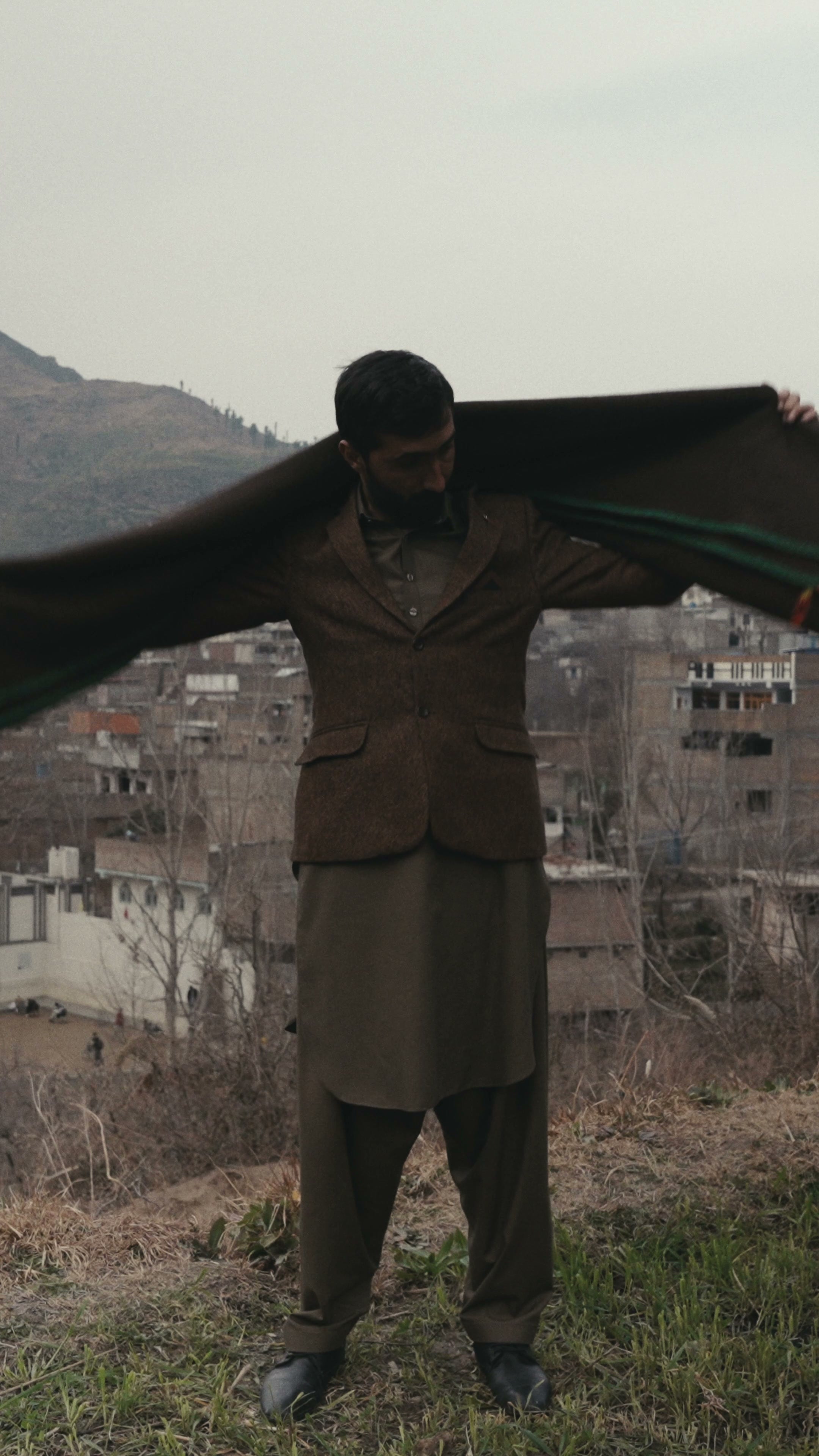
The rest is mostly about names, because "shawl" gets stuck on everything from a slim stole to something you could sleep under.
A rough size chart
None of these terms is regulated, and two shops can sell the same cloth as a wrap and as a shawl. But the trade has settled on some loose conventions.
| Name | Typical size | What it does | |---|---|---| | Scarf | about 30 × 180 cm | Goes round the neck, not the shoulders | | Stole | about 70 × 200 cm | The classic pashmina size. Long and fairly narrow | | Wrap | about 80 to 100 × 200 cm | A wider stole. Covers the shoulders, some of the back | | Shawl | 100 × 200 cm to 120 × 240 cm | Covers shoulders and back. Can stand in for a jacket | | Blanket scarf | 140 cm and up on the short side | Often a big square on the high street. At the top end, it is really a blanket |
If a listing only gives one number, be suspicious. A "200 cm shawl" could be 70 cm wide or 120 cm wide, and those are very different things to wear.
What the length does
Length decides where the ends land. Drape a shawl across your shoulders and roughly 50 cm of it runs across your back. Whatever is left splits into two tails down the front.
On a 200 cm shawl that leaves about 75 cm a side. On someone of 168 cm, that brings the ends to around mid-thigh. On someone of 185 cm the tails stop higher up, and there isn't quite enough spare to throw one end over the opposite shoulder and have it stay put. A 240 cm shawl gives the taller person about 95 cm a side and puts the ends back in roughly the same place on the leg.
So the two common shawl sizes aren't really "regular" and "large". They are the same proportion, scaled for two lengths of body. The drapes and knots themselves are covered in our guide on how to wear a shawl, so I won't repeat them here. The short version is that most of them need a spare 20 or 30 cm beyond a simple drape.
What the width does
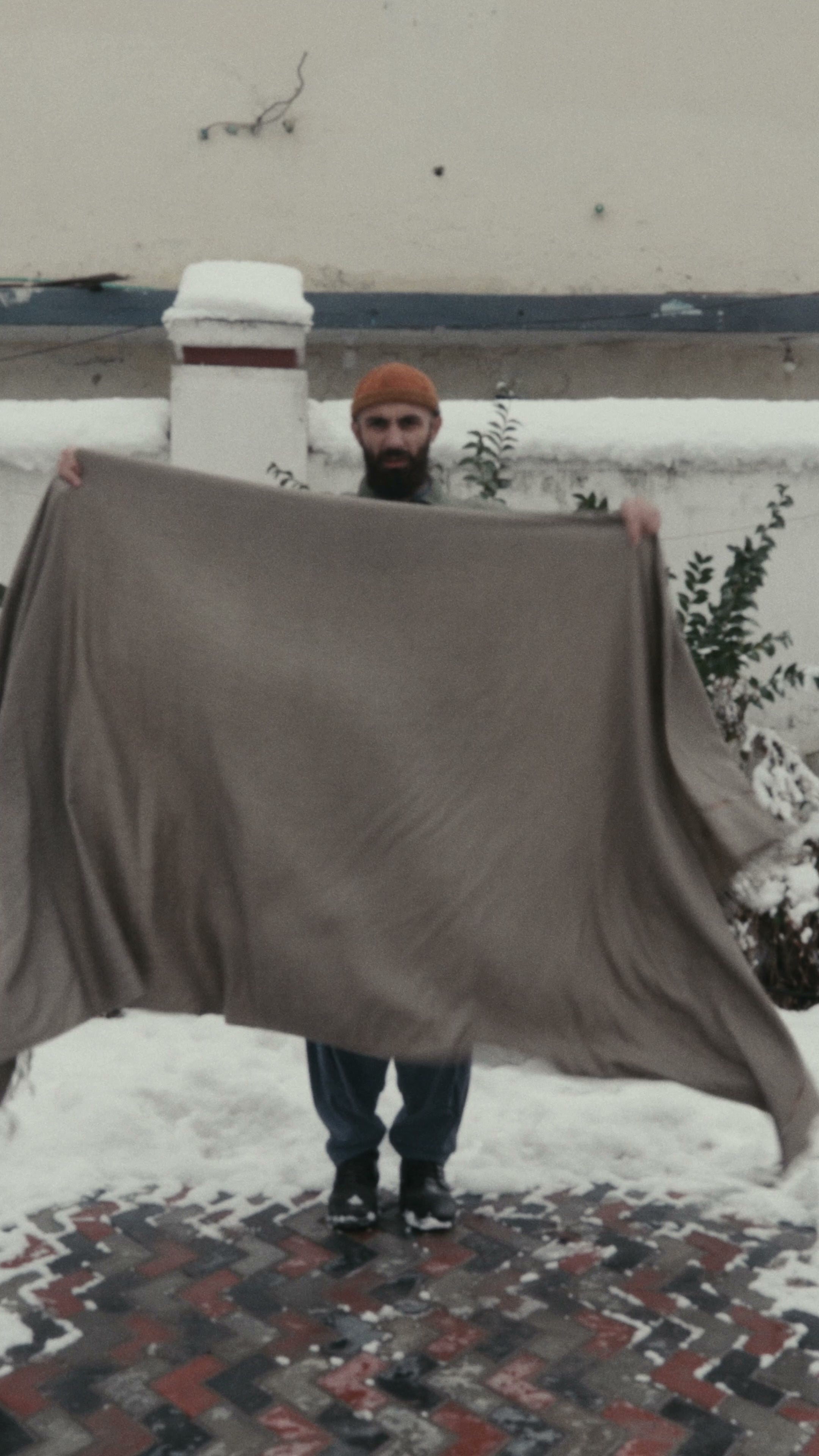
Width is about coverage and folding. Very few people wear a shawl fully open; the usual move is to fold it lengthways first, which doubles the wool over your shoulders. A 70 cm stole folded in half is a 35 cm band, which is basically a thick scarf. A 100 cm shawl folds to 50 cm, and a 120 cm one to 60 cm, enough to sit across the shoulders and upper back in two layers.
This is where your frame matters more than your height. On broad shoulders, the 60 cm fold lies flat and covers properly. On a narrow frame the same fold can bunch up at the neck, and the smaller width often looks tidier.
Bigger is heavier
Bigger means heavier. Going from 100 × 200 cm to 120 × 240 cm adds 44% more cloth, because the area jumps from 2 to 2.88 square metres. On our Midweight, woven at 280 GSM, that works out on paper at about 560 g for the smaller size and just over 800 g for the larger (before fringes). Outdoors in January you will be glad of every gram. Draped over a chair in a warm office, the larger size is a lot of wool to carry about.
My own view: if you mainly want a shawl as a coat substitute, size up. If it is mostly for indoors, trains and evenings, the smaller one is easier to live with, even if you are on the tall side.
SHAAL sizes
Our wearable shawls come in two sizes, 100 × 200 cm and 120 × 240 cm, across the Midweight, Heavyweight, yak blend and pashmina blend. The Guide to SHAAL suggests the smaller size up to 178 cm tall and the larger from 179 cm, and says to size up if you are between the two. The blanket is 150 × 270 cm, and we treat it as a blanket for the sofa or bed, not something to wear to the shops.
Measuring for yourself
Measure from the top of your shoulder down to where you want the tails to finish. Double that number and add 50 cm for the stretch across your back. That is your length. For most adults it lands somewhere between 200 and 240 cm, which is why those two sizes keep turning up. For width, fold a bath towel or a sheet to 50 cm and then 60 cm, put each over your shoulders in front of a mirror, and see which one sits flat.