
The first cold morning of October tends to go the same way. You pull a shawl out of the drawer where it spent the summer and find a neat grid of fold lines across it, as if it had arrived in an envelope. It looks worse than it is. Wool forgives creasing better than almost any other fibre, and most of those lines will drop out within a few days whether you do anything or not.
If you want it right today, here are the options, gentlest first.
Why wool creases, and why it lets go
A wool fibre is crimped, a natural wave along its length, and inside it the protein chains are folded back on themselves like a coiled spring. The American Sheep Industry Association puts numbers on it: wool can stretch about 30% when dry (up to 50% wet) and still return to its original length. Linen and cotton have nothing like that bounce.
The catch is time and pressure. Six months at the bottom of a stack holds the fibres bent long enough that they settle into the fold. What releases them is moisture. Wool takes up water vapour readily, around 30% of its own weight before it even feels damp, and it recovers from strain faster in humid air. Every method below works on that principle: a little moisture, a little warmth, then let the fibres relax on their own. You're not flattening the cloth so much as reminding it of its shape.
Start by doing nothing
Wear it. Body warmth and the damp in the air do a slow version of steaming, and the weight of the cloth hanging from your shoulders pulls the folds down. Soft storage creases in a medium or heavy shawl are often gone after a day or two. It costs nothing and can't go wrong.
If you'd rather not wear the creases, drape the shawl over a chair back or a towel rail overnight. Not on a hanger for weeks (that's how wool slowly stretches), just long enough for gravity to help.
The steamy bathroom
One step up. Hang the shawl over the shower rail or the top of the door, run a hot shower with the door shut, and leave it in the steam for 15 or 20 minutes. Then move it somewhere airy and let it dry, still draped. Fold it away damp and you'll set a fresh crease exactly where you didn't want one. This clears most summer fold lines by itself, and gets rid of that faint smell of drawer.
A handheld steamer, held off the cloth
For stubborn lines, a handheld garment steamer is the most useful thing you can own for wool. Hang the shawl, hold the head a couple of centimetres from the surface and move it slowly along the crease. Don't press it into the wool. The steam does the work, and contact only risks a wet patch or a flattened spot. Smooth the area lightly with your hand afterwards (carefully, it's hot) and let it dry before wearing.
On a handwoven piece, this is the method we'd choose every time. Cloth from a manual loom has a slight unevenness to its surface that is part of the point, and steam relaxes the crease while leaving that texture alone. Our own Guide to SHAAL says the same in fewer words: low steam, gently, to restore the drape.
Why we'd leave the iron alone
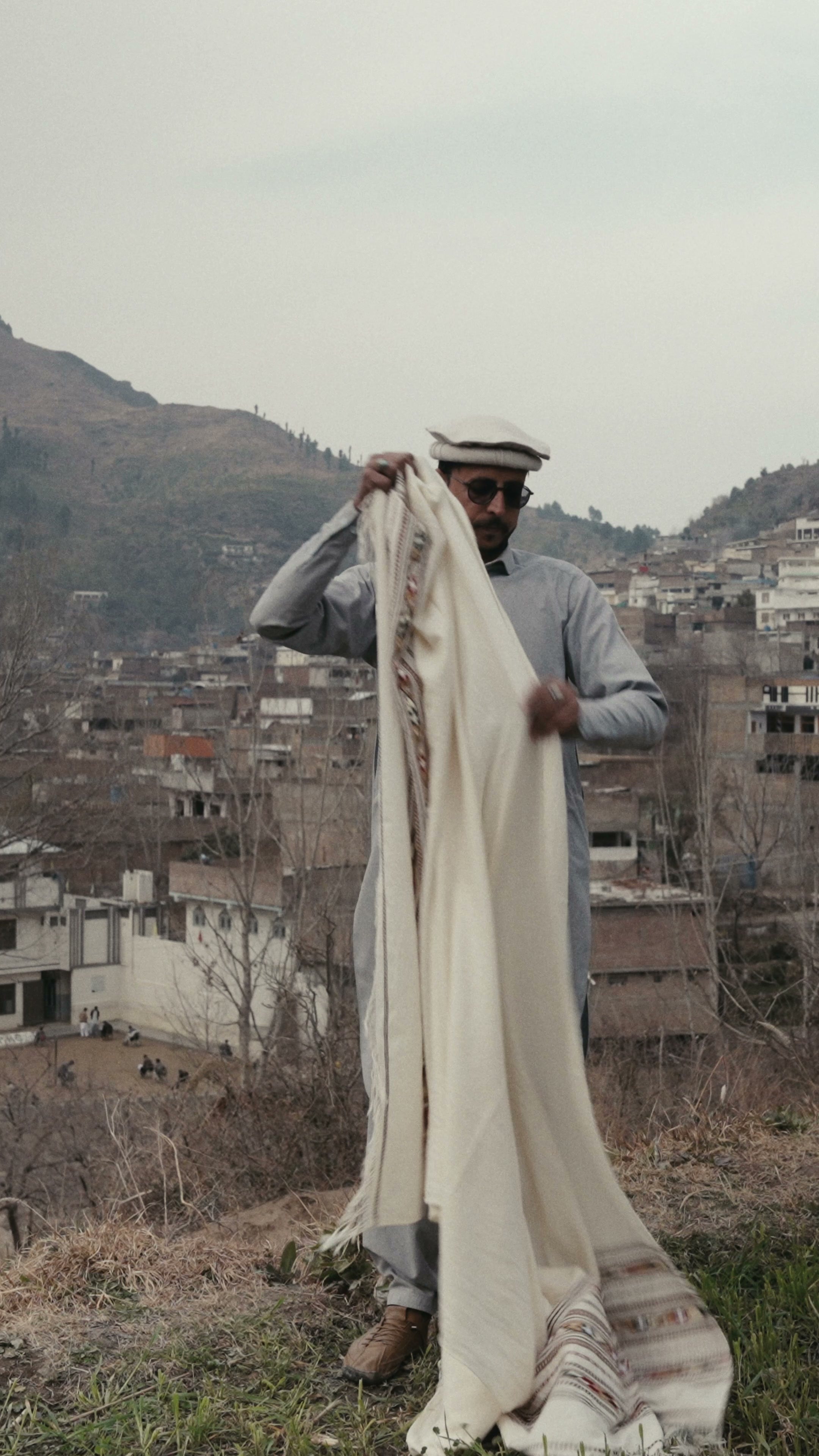
People reach for the iron out of habit, and on a handwoven shawl it's the wrong tool. Our care guide says no heat, and we mean it. Even on the wool setting, the plate flattens the loft out of the cloth and can leave a shiny, crushed patch that is very hard to undo. On something like our handwoven heavyweight shawl, lamb's wool woven on manual Khadi looms in the Swat Valley, that loft is where the warmth lives. If a fold has survived the bathroom and the steamer, give it another night on a hanger in a damp room. It will go.
What not to do
- High heat. The cotton or linen setting will scorch or yellow wool.
- Soaking it and wringing it out. Twisting distorts the weave. If a shawl needs proper wetting, it needs a proper wash, which is a different job (our post on washing a wool shawl covers it).
- The tumble dryer, even on a "de-wrinkle" setting. Heat plus tumbling is how wool felts and shrinks, and felting doesn't reverse.
Fewer creases next autumn
Wool shouldn't hang for months, so some folding is unavoidable. Aim for soft folds rather than none. Fold loosely without pressing the folds flat, and lay a sheet of acid-free tissue inside each one so it can't form a hard line. If the drawer is long enough, rolling beats folding altogether. Keep it on top of the pile, not under four jumpers. The rest (cleaning before it goes away, moths, breathable bags) is in our guide to storing wool over summer.
For this week, try the shower first and leave the iron in the cupboard where it belongs. Most of the time the shawl will have sorted itself out before you'd have needed it.